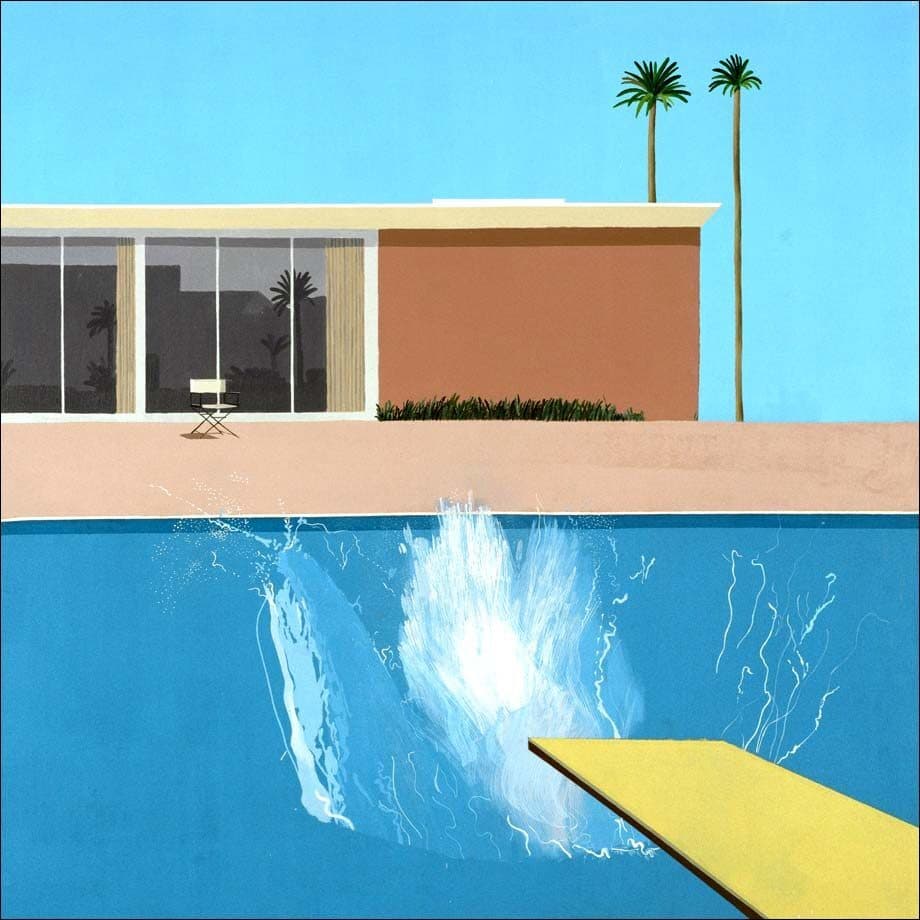
David Hockney: The passing of a visionary painter of contemporary art
David Hockney, a major figure in contemporary art, transformed painting through color, artificial space, perspective, and digital works created on the iPad.
David Hockney: The Passing of a Painter Who Changed the Way We See
The passing of David Hockney marks the end of an extraordinary artistic career, but not the end of his influence.
A major British painter and a central figure in contemporary art, Hockney profoundly transformed painting by imbuing it with a dimension that is at once luminous, artificial, constructed, and modern.
His Californian swimming pools, his portraits, his landscapes of Yorkshire or Normandy are never merely realistic images. In Hockney’s work, reality is always reimagined. Color becomes more intense than in nature. Space seems flattened, cut out, almost theatrical. Classical perspective is disrupted in favor of a more mental, freer, and more contemporary vision.
This is undoubtedly one of his most significant contributions: Hockney demonstrated that painting could remain figurative without being academic. It could represent the world while embracing its own artifice.
Long before digital technology became central to contemporary art, David Hockney explored technological tools as genuine instruments of painting. Photocopies, faxes, Polaroids, photo collages, iPhone, iPad: he never pitted tradition against innovation.
His digital paintings created on an iPad are a direct extension of his body of work. They do not represent a break from painting, but rather another way of painting: more immediate, more mobile, and more luminous. With the iPad, Hockney has shifted the act of painting to the screen, without losing his essential connection to color, light, and observation.
Through this practice, he anticipated a central question of our time: what becomes of painting when the image passes through the screen?
Hockney has never ceased to answer this question through his work. For him, painting was not a medium of the past, but a language capable of absorbing new technologies. His work thus bridges the gap between classical painting, photography, the digital image, and the contemporary visual experience.
His passing serves as a reminder of the significance of an artist who spanned several eras without ever becoming stuck in a single style. Hockney painted modernity not as a subject, but as a way of seeing.
He leaves behind an immense body of work—joyful, artificial, sensitive, and profoundly free.